Paperless Hospitals: The Simple Shift Transforming Efficiency, Care, and Sustainability
Dec 5, 2025
Paperless Hospitals: The Simple Shift Transforming Efficiency, Care, and Sustainability
Hospitals today are busier than ever - more patients, more documentation, more compliance requirements, and more pressure to deliver faster, safer, and more coordinated care. Yet, even in 2025, one thing remains surprisingly unchanged: paper.
Walk into a ward, and you’ll still find nurses juggling patient files, doctors flipping through notes, and admin teams waiting for one physical folder to move from desk to desk. Paper feels familiar… but it quietly slows hospitals down in ways most leaders underestimate.
The idea of a paperless hospital might sound futuristic, expensive, or complicated—but the truth is the opposite. With modern tools designed around existing clinical behavior, hospitals are shifting to digital documentation without disrupting workflows or adding pressure on doctors and nurses.
Let’s explore why paperless hospitals are gaining momentum, what’s driving the change, and how this shift is improving efficiency, patient care, and sustainability—all with a surprisingly simple approach.
Why Are Hospitals Still Using Paper?
It’s not because paper is better.
It’s because it feels easy.
Doctors write quickly. Nurses rely on muscle memory. Typing is slow. Complex EMRs can be overwhelming. And most digital systems haven’t been designed to match how Indian hospitals actually work.
This is why around 95% of IPD documentation in India is still paper-based—even though everyone knows paper creates inefficiency.
But here’s the real insight:
Hospitals don’t resist digital transformation. They resist workflow disruption.
Any system that forces major behavior change creates friction. The key to going paperless is adopting tools that feel natural, intuitive, and effortless.
What Paper Really Costs Hospitals
Paper appears inexpensive… until you add the hidden operational costs.
A. Discharge Delays
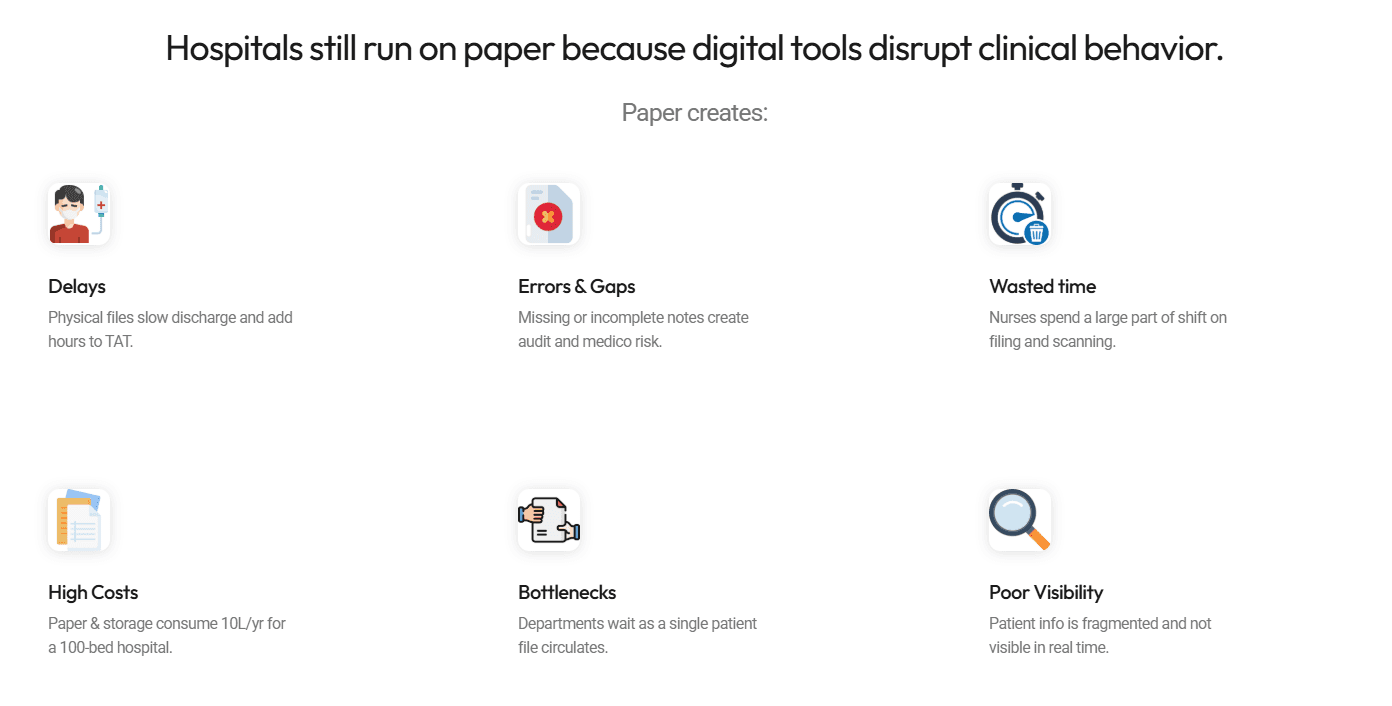
A single patient file moves through departments—doctor, nurse, billing, insurance, MRD—and this movement alone creates hours of delay. In many hospitals, discharge turnaround time is 6–7 hours simply because everyone depends on one physical file.
B. Nurses Spend 1/3rd of Their Time on Paperwork
Punching, stapling, preparing files, rewriting notes, updating multiple copies…
This is time taken away from patient care, leading to burnout and inefficiency.
C. No Real-Time Visibility
If the file is in ICU, the doctor in OPD can’t see it.
If billing has it, nurses can’t update it.
This lack of shared access slows clinical decisions and administrative processes.
D. MRD Chaos
Storing files, retrieving files, scanning, maintaining physical archives—
All of this requires manpower, space, and money.
E. Environmental Impact
A typical mid-sized hospital generates tens of thousands of pages a month.
Paper production requires water, trees, energy, and contributes to carbon emissions.
Paper feels simple.
But it quietly makes hospitals slower, more expensive, and less coordinated.
What a Paperless Hospital Actually Looks Like
Most people imagine a paperless hospital as a place full of computers, long training sessions, and complicated EMRs.
The modern reality is very different.
Today’s best digital IPD systems allow:
Doctors to write naturally using a stylus
Nurses to document exactly as they always have
All notes to be saved instantly
Every department to access the latest records in real time
Zero typing pressure
Zero workflow disruption
This is why adoption becomes easy.
The technology adapts to the hospital—not the other way around.
A good paperless IPD system feels like writing on paper… just smarter, faster, and available everywhere.
How Paperless Hospitals Improve Efficiency (Without Changing Behavior)
A. Discharges Become Faster
Billing, nursing, and doctors can update and view notes simultaneously.
No waiting.
No chasing the physical file.
No bottlenecks.
Hospitals report dramatic reductions in discharge times after going paperless.
B. Nurses Save Hours Every Day
When documentation becomes digital—and natural—nurses save thousands of minutes otherwise lost to manual paperwork.
This frees them to:
Monitor patients more effectively
Reduce stress during peak hours
Improve handovers
Deliver better care
Hospitals see this in their staff morale almost immediately.
C. Doctors Stay Updated in Real Time
Whether a doctor is on rounds, in OPD, or offsite, they can access patient charts digitally.
No more waiting for a file to arrive.
No more missing information.
No more delays due to documentation gaps.
This alone transforms the quality of decision-making.
D. MRD Becomes Efficient
No physical storage rooms.
No scanning.
No manual file retrieval.
No misplaced documents.
Every record is stored securely and can be retrieved in seconds.
E. Compliance Becomes Simple
Digital systems automatically:
Timestamp entries
Track signatures
Maintain audit logs
Provide role-based access
This makes hospitals more aligned with NABH requirements and reduces compliance burden.
F. Better Data, Better Insights
Once documentation is digital, hospitals gain analytics:
Patient flow patterns
Nurse workload analysis
Diagnosis trends
Discharge time insights
Bed utilization trends
These insights can help improve operations, staffing, and resource planning.
Sustainability: The Hidden Superpower of Paperless Hospitals
Going paperless isn’t just an operational upgrade—it’s an environmental commitment.
Paper production requires:
Huge amounts of water
Trees
Energy
Transportation
Chemical processing
A single sheet of paper consumes around 1 liter of water and releases carbon during production. Multiply that across thousands of pages per month… and hospitals play a significant role in environmental impact.
Paperless hospitals:
Save thousands of trees
Reduce waste
Shrink carbon footprint
Improve ESG performance
Demonstrate responsible leadership
Patients increasingly value environmentally conscious organizations, making this an added advantage.
Why Hospitals Can No Longer Ignore the Paperless Shift
Three big forces are pushing healthcare into a digital-first future:
1. Patient Expectations
People expect fast discharges, organized care, and professionalism.
2. Regulatory Demands
Digital patient records are becoming standard in accreditation frameworks.
3. Operational Pressures
Hospitals must do more with less—less time, less staff, less manual work.
Going paperless is no longer a “nice to have.”
It’s a competitive advantage.
And because modern systems mimic real hospital workflows—writing, documenting, reviewing—the transition is smoother than ever.
The Future of Hospitals Is Clear
A paperless hospital isn’t a “tech hospital.”
It’s a human-first hospital:
Nurses with more time
Doctors with better visibility
Patients with faster service
Admins with fewer bottlenecks
Leaders with better data
The planet with less waste
The biggest shift hospitals experience isn’t digital—it’s emotional.
People feel lighter.
Workflows feel smoother.
The whole hospital moves with more clarity and confidence.
The transition is no longer about technology.
It’s about removing friction, waste, and unnecessary delays from healthcare.
And that starts with something as simple as removing paper.
Looking to understand hospital digitization more deeply?
Here are two helpful links:
Visit Dscribe Home for an overview of how we make hospital documentation effortless.
Read Our Previous Blog: Why Are Hospitals Still Drowning in Paper? And Why It Doesn’t Have To Be This Way

Paperless Hospitals: The Simple Shift Transforming Efficiency, Care, and Sustainability
Dec 5, 2025
Dec 5, 2025
Paperless Hospitals: The Simple Shift Transforming Efficiency, Care, and Sustainability
Hospitals today are busier than ever - more patients, more documentation, more compliance requirements, and more pressure to deliver faster, safer, and more coordinated care. Yet, even in 2025, one thing remains surprisingly unchanged: paper.
Walk into a ward, and you’ll still find nurses juggling patient files, doctors flipping through notes, and admin teams waiting for one physical folder to move from desk to desk. Paper feels familiar… but it quietly slows hospitals down in ways most leaders underestimate.
The idea of a paperless hospital might sound futuristic, expensive, or complicated—but the truth is the opposite. With modern tools designed around existing clinical behavior, hospitals are shifting to digital documentation without disrupting workflows or adding pressure on doctors and nurses.
Let’s explore why paperless hospitals are gaining momentum, what’s driving the change, and how this shift is improving efficiency, patient care, and sustainability—all with a surprisingly simple approach.
Why Are Hospitals Still Using Paper?
It’s not because paper is better.
It’s because it feels easy.
Doctors write quickly. Nurses rely on muscle memory. Typing is slow. Complex EMRs can be overwhelming. And most digital systems haven’t been designed to match how Indian hospitals actually work.
This is why around 95% of IPD documentation in India is still paper-based—even though everyone knows paper creates inefficiency.
But here’s the real insight:
Hospitals don’t resist digital transformation. They resist workflow disruption.
Any system that forces major behavior change creates friction. The key to going paperless is adopting tools that feel natural, intuitive, and effortless.
What Paper Really Costs Hospitals
Paper appears inexpensive… until you add the hidden operational costs.
A. Discharge Delays
A single patient file moves through departments—doctor, nurse, billing, insurance, MRD—and this movement alone creates hours of delay. In many hospitals, discharge turnaround time is 6–7 hours simply because everyone depends on one physical file.
B. Nurses Spend 1/3rd of Their Time on Paperwork
Punching, stapling, preparing files, rewriting notes, updating multiple copies…
This is time taken away from patient care, leading to burnout and inefficiency.
C. No Real-Time Visibility
If the file is in ICU, the doctor in OPD can’t see it.
If billing has it, nurses can’t update it.
This lack of shared access slows clinical decisions and administrative processes.
D. MRD Chaos
Storing files, retrieving files, scanning, maintaining physical archives—
All of this requires manpower, space, and money.
E. Environmental Impact
A typical mid-sized hospital generates tens of thousands of pages a month.
Paper production requires water, trees, energy, and contributes to carbon emissions.
Paper feels simple.
But it quietly makes hospitals slower, more expensive, and less coordinated.
What a Paperless Hospital Actually Looks Like
Most people imagine a paperless hospital as a place full of computers, long training sessions, and complicated EMRs.
The modern reality is very different.
Today’s best digital IPD systems allow:
Doctors to write naturally using a stylus
Nurses to document exactly as they always have
All notes to be saved instantly
Every department to access the latest records in real time
Zero typing pressure
Zero workflow disruption
This is why adoption becomes easy.
The technology adapts to the hospital—not the other way around.
A good paperless IPD system feels like writing on paper… just smarter, faster, and available everywhere.
How Paperless Hospitals Improve Efficiency (Without Changing Behavior)
A. Discharges Become Faster
Billing, nursing, and doctors can update and view notes simultaneously.
No waiting.
No chasing the physical file.
No bottlenecks.
Hospitals report dramatic reductions in discharge times after going paperless.
B. Nurses Save Hours Every Day
When documentation becomes digital—and natural—nurses save thousands of minutes otherwise lost to manual paperwork.
This frees them to:
Monitor patients more effectively
Reduce stress during peak hours
Improve handovers
Deliver better care
Hospitals see this in their staff morale almost immediately.
C. Doctors Stay Updated in Real Time
Whether a doctor is on rounds, in OPD, or offsite, they can access patient charts digitally.
No more waiting for a file to arrive.
No more missing information.
No more delays due to documentation gaps.
This alone transforms the quality of decision-making.
D. MRD Becomes Efficient
No physical storage rooms.
No scanning.
No manual file retrieval.
No misplaced documents.
Every record is stored securely and can be retrieved in seconds.
E. Compliance Becomes Simple
Digital systems automatically:
Timestamp entries
Track signatures
Maintain audit logs
Provide role-based access
This makes hospitals more aligned with NABH requirements and reduces compliance burden.
F. Better Data, Better Insights
Once documentation is digital, hospitals gain analytics:
Patient flow patterns
Nurse workload analysis
Diagnosis trends
Discharge time insights
Bed utilization trends
These insights can help improve operations, staffing, and resource planning.
Sustainability: The Hidden Superpower of Paperless Hospitals
Going paperless isn’t just an operational upgrade—it’s an environmental commitment.
Paper production requires:
Huge amounts of water
Trees
Energy
Transportation
Chemical processing
A single sheet of paper consumes around 1 liter of water and releases carbon during production. Multiply that across thousands of pages per month… and hospitals play a significant role in environmental impact.
Paperless hospitals:
Save thousands of trees
Reduce waste
Shrink carbon footprint
Improve ESG performance
Demonstrate responsible leadership
Patients increasingly value environmentally conscious organizations, making this an added advantage.
Why Hospitals Can No Longer Ignore the Paperless Shift
Three big forces are pushing healthcare into a digital-first future:
1. Patient Expectations
People expect fast discharges, organized care, and professionalism.
2. Regulatory Demands
Digital patient records are becoming standard in accreditation frameworks.
3. Operational Pressures
Hospitals must do more with less—less time, less staff, less manual work.
Going paperless is no longer a “nice to have.”
It’s a competitive advantage.
And because modern systems mimic real hospital workflows—writing, documenting, reviewing—the transition is smoother than ever.
The Future of Hospitals Is Clear
A paperless hospital isn’t a “tech hospital.”
It’s a human-first hospital:
Nurses with more time
Doctors with better visibility
Patients with faster service
Admins with fewer bottlenecks
Leaders with better data
The planet with less waste
The biggest shift hospitals experience isn’t digital—it’s emotional.
People feel lighter.
Workflows feel smoother.
The whole hospital moves with more clarity and confidence.
The transition is no longer about technology.
It’s about removing friction, waste, and unnecessary delays from healthcare.
And that starts with something as simple as removing paper.
Looking to understand hospital digitization more deeply?
Here are two helpful links:
Visit Dscribe Home for an overview of how we make hospital documentation effortless.
Read Our Previous Blog: Why Are Hospitals Still Drowning in Paper? And Why It Doesn’t Have To Be This Way
Paperless Hospitals: The Simple Shift Transforming Efficiency, Care, and Sustainability
Paperless Hospitals: The Simple Shift Transforming Efficiency, Care, and Sustainability
Hospitals today are busier than ever - more patients, more documentation, more compliance requirements, and more pressure to deliver faster, safer, and more coordinated care. Yet, even in 2025, one thing remains surprisingly unchanged: paper.
Walk into a ward, and you’ll still find nurses juggling patient files, doctors flipping through notes, and admin teams waiting for one physical folder to move from desk to desk. Paper feels familiar… but it quietly slows hospitals down in ways most leaders underestimate.
The idea of a paperless hospital might sound futuristic, expensive, or complicated—but the truth is the opposite. With modern tools designed around existing clinical behavior, hospitals are shifting to digital documentation without disrupting workflows or adding pressure on doctors and nurses.
Let’s explore why paperless hospitals are gaining momentum, what’s driving the change, and how this shift is improving efficiency, patient care, and sustainability—all with a surprisingly simple approach.
Why Are Hospitals Still Using Paper?
It’s not because paper is better.
It’s because it feels easy.
Doctors write quickly. Nurses rely on muscle memory. Typing is slow. Complex EMRs can be overwhelming. And most digital systems haven’t been designed to match how Indian hospitals actually work.
This is why around 95% of IPD documentation in India is still paper-based—even though everyone knows paper creates inefficiency.
But here’s the real insight:
Hospitals don’t resist digital transformation. They resist workflow disruption.
Any system that forces major behavior change creates friction. The key to going paperless is adopting tools that feel natural, intuitive, and effortless.
What Paper Really Costs Hospitals
Paper appears inexpensive… until you add the hidden operational costs.
A. Discharge Delays
A single patient file moves through departments—doctor, nurse, billing, insurance, MRD—and this movement alone creates hours of delay. In many hospitals, discharge turnaround time is 6–7 hours simply because everyone depends on one physical file.
B. Nurses Spend 1/3rd of Their Time on Paperwork
Punching, stapling, preparing files, rewriting notes, updating multiple copies…
This is time taken away from patient care, leading to burnout and inefficiency.
C. No Real-Time Visibility
If the file is in ICU, the doctor in OPD can’t see it.
If billing has it, nurses can’t update it.
This lack of shared access slows clinical decisions and administrative processes.
D. MRD Chaos
Storing files, retrieving files, scanning, maintaining physical archives—
All of this requires manpower, space, and money.
E. Environmental Impact
A typical mid-sized hospital generates tens of thousands of pages a month.
Paper production requires water, trees, energy, and contributes to carbon emissions.
Paper feels simple.
But it quietly makes hospitals slower, more expensive, and less coordinated.
What a Paperless Hospital Actually Looks Like
Most people imagine a paperless hospital as a place full of computers, long training sessions, and complicated EMRs.
The modern reality is very different.
Today’s best digital IPD systems allow:
Doctors to write naturally using a stylus
Nurses to document exactly as they always have
All notes to be saved instantly
Every department to access the latest records in real time
Zero typing pressure
Zero workflow disruption
This is why adoption becomes easy.
The technology adapts to the hospital—not the other way around.
A good paperless IPD system feels like writing on paper… just smarter, faster, and available everywhere.
How Paperless Hospitals Improve Efficiency (Without Changing Behavior)
A. Discharges Become Faster
Billing, nursing, and doctors can update and view notes simultaneously.
No waiting.
No chasing the physical file.
No bottlenecks.
Hospitals report dramatic reductions in discharge times after going paperless.
B. Nurses Save Hours Every Day
When documentation becomes digital—and natural—nurses save thousands of minutes otherwise lost to manual paperwork.
This frees them to:
Monitor patients more effectively
Reduce stress during peak hours
Improve handovers
Deliver better care
Hospitals see this in their staff morale almost immediately.
C. Doctors Stay Updated in Real Time
Whether a doctor is on rounds, in OPD, or offsite, they can access patient charts digitally.
No more waiting for a file to arrive.
No more missing information.
No more delays due to documentation gaps.
This alone transforms the quality of decision-making.
D. MRD Becomes Efficient
No physical storage rooms.
No scanning.
No manual file retrieval.
No misplaced documents.
Every record is stored securely and can be retrieved in seconds.
E. Compliance Becomes Simple
Digital systems automatically:
Timestamp entries
Track signatures
Maintain audit logs
Provide role-based access
This makes hospitals more aligned with NABH requirements and reduces compliance burden.
F. Better Data, Better Insights
Once documentation is digital, hospitals gain analytics:
Patient flow patterns
Nurse workload analysis
Diagnosis trends
Discharge time insights
Bed utilization trends
These insights can help improve operations, staffing, and resource planning.
Sustainability: The Hidden Superpower of Paperless Hospitals
Going paperless isn’t just an operational upgrade—it’s an environmental commitment.
Paper production requires:
Huge amounts of water
Trees
Energy
Transportation
Chemical processing
A single sheet of paper consumes around 1 liter of water and releases carbon during production. Multiply that across thousands of pages per month… and hospitals play a significant role in environmental impact.
Paperless hospitals:
Save thousands of trees
Reduce waste
Shrink carbon footprint
Improve ESG performance
Demonstrate responsible leadership
Patients increasingly value environmentally conscious organizations, making this an added advantage.
Why Hospitals Can No Longer Ignore the Paperless Shift
Three big forces are pushing healthcare into a digital-first future:
1. Patient Expectations
People expect fast discharges, organized care, and professionalism.
2. Regulatory Demands
Digital patient records are becoming standard in accreditation frameworks.
3. Operational Pressures
Hospitals must do more with less—less time, less staff, less manual work.
Going paperless is no longer a “nice to have.”
It’s a competitive advantage.
And because modern systems mimic real hospital workflows—writing, documenting, reviewing—the transition is smoother than ever.
The Future of Hospitals Is Clear
A paperless hospital isn’t a “tech hospital.”
It’s a human-first hospital:
Nurses with more time
Doctors with better visibility
Patients with faster service
Admins with fewer bottlenecks
Leaders with better data
The planet with less waste
The biggest shift hospitals experience isn’t digital—it’s emotional.
People feel lighter.
Workflows feel smoother.
The whole hospital moves with more clarity and confidence.
The transition is no longer about technology.
It’s about removing friction, waste, and unnecessary delays from healthcare.
And that starts with something as simple as removing paper.
Looking to understand hospital digitization more deeply?
Here are two helpful links:
Visit Dscribe Home for an overview of how we make hospital documentation effortless.
Read Our Previous Blog: Why Are Hospitals Still Drowning in Paper? And Why It Doesn’t Have To Be This Way
Dec 5, 2025

Frequently
asked question
Answers to your asked queries
What ROI can hospitals expect after implementing DScribe?
For a 100-bed hospital, DScribe typically delivers ₹25 lakhs or more in annual savings by reducing paper usage, physical storage, and file-handling overhead. Hospitals also experience a 30–35% productivity improvement across clinical teams, enabling faster and more coordinated patient care.
Will doctors and nurses need to change how they work?
How long does it take to implement DScribe in a hospital department?
Are DScribe digital records accepted for NABH and insurance audits?
Does DScribe work only for inpatient care?
How secure are patient records in DScribe?
Does DScribe reduce nursing workload?
Frequently
asked question
Answers to your asked queries
What ROI can hospitals expect after implementing DScribe?
For a 100-bed hospital, DScribe typically delivers ₹25 lakhs or more in annual savings by reducing paper usage, physical storage, and file-handling overhead. Hospitals also experience a 30–35% productivity improvement across clinical teams, enabling faster and more coordinated patient care.
Will doctors and nurses need to change how they work?
How long does it take to implement DScribe in a hospital department?
Are DScribe digital records accepted for NABH and insurance audits?
Does DScribe work only for inpatient care?
How secure are patient records in DScribe?
Does DScribe reduce nursing workload?
Frequently
asked question
Answers to your asked queries
What ROI can hospitals expect after implementing DScribe?
For a 100-bed hospital, DScribe typically delivers ₹25 lakhs or more in annual savings by reducing paper usage, physical storage, and file-handling overhead. Hospitals also experience a 30–35% productivity improvement across clinical teams, enabling faster and more coordinated patient care.
Will doctors and nurses need to change how they work?
How long does it take to implement DScribe in a hospital department?
Are DScribe digital records accepted for NABH and insurance audits?
Does DScribe work only for inpatient care?
How secure are patient records in DScribe?
Does DScribe reduce nursing workload?